Thursday, May 19, 2022

Roster Reactions and 2022 MLQ Season Preview

One of the more interesting roster reveals in Major League Quidditch history dropped two weeks ago, with notable names popping up in unexpected places, rising college stars slated to make their summer debuts and a few surprise retirements across the country. After a new champion was crowned in the club division at US Quidditch Cup and a wide range of young players burst onto the scene in the college division, the rosters were announced in a climate of tantalizing expectations that the 2022 season could be the most closely contested yet. As teams hold their first few practices and players travel from the outer reaches of their recruiting radii, I had some thoughts based on the rosters about the storylines for each division. I am admittedly a little rusty as a quidditch blogger, but I have now been back around the sport for a full MLQ season and a full USQ season, so I have no excuse! 

A Changing of the Guard?

One of the biggest questions for the league is whether the longtime dominance of the Boston Forge and the New York Titans atop the East Division will come to an end in 2022. The two rivals have finished either first or second in every season except one, with the Forge taking five consecutive division titles before the Titans finally knocked off their northern neighbors last year. Coming off USQ campaigns that fell short and heading into the 2022 MLQ season, neither team is necessarily favored though.

The Washington Admirals, fresh off a run to the semifinals at US Quidditch Cup by the Bosny Bearsharks without star players Julia Baer and Tyler Trudeau, were the early pick of MLQ co-commissioner Ethan Sturm. The Admirals have been making strides for several seasons now and the hard work of building a strong culture started to pay off last year, when Washington became the first team to defeat the Boston Forge in a regular season series and developed one of the prettiest passing offenses that quidditch has ever seen. There was a magic on their home turf outside RFK Stadium, where they believed they could beat any team, and all the key figures are coming back according to the revealed roster.

Photo by Chiddy Powers.

With fewer home series in 2022 however, Washington will have to remain focused during the regular season because the ultimate goal is the same: a deep run before a hometown crowd in Howard County at the MLQ Championship. A year ago, the Admirals ran into the buzzsaw of the eventual champion Austin Outlaws in the quarterfinals before they could gather any momentum. To avoid a repeat scenario, the capital region squad will have to earn a higher seed by winning on the road in New York and Boston, a tough proposition for the beating corps especially. 

The additions of former Maryland star Zain Bhalia and current Maryland standout Heather Farnan will provide much-needed depth, but continued development from the returning trio of Melissa Smith, Cody Nardone, and Bernie Berges is just as crucial. The three veterans stabilized a position that previously given Washington trouble last season and at times outplayed flashier opponents but the question of whether they can thrive as high-level beating speeds up and be the go-to beaters on a championship team is open. 

Another team that is highly energized by a strong USQ season and could disrupt the duopoly of Boston and New York is the trial expansion team, the Charlotte Aviators. The Aviators took a game off the Titans, who eventually reached the finals, at the MLQ Championship last year and have the beating depth to hang with any team. They also have the top-performing seeker in the league in Ryan Davis, which means that more than any other positional unit, the burden lies with the chasers to elevate their games. 

Photo by Mike Iadevaia.

Under the leadership of head coach Lee Hodge, the Aviators offense has come a long way, with a relatively one-dimensional attack becoming dynamic and multi-faceted over the course of the 2021 season. Davis has a killer midrange shot, Hodge is one of the best in the sport at working in underutilized spaces on the wing, and Logan Hartman can come out of nowhere and turn garbage into gold around the hoops. What is holding the Aviators back is a combination of two things: a lack of incorporation of their women chasers in strategic ways and an underdeveloped press on the defensive end. 

Goals do not always come easy for Charlotte, and finding ways to move the ball and get counterattacking opportunities is part of the solution. With Diana Howard transferring to the Washington Admirals roster and Erin Smekrud appearing on the practice squad, Charlotte will need its new additions at chaser who are women to step up. But the coaching staff needs to have a real plan to take advantage of their skillsets. Similarly, players like Quincy Hildreth are deadly on the fast break but do not get nearly enough chances to run in the open field because of a lack of coordination on defense. The bar is exceptionally high for a trial expansion team, but the Aviators have every reason to believe they could win the division with their  trajectory over the past few years.

Despite all the energy around the two potential challengers, Boston and New York will be hard to unseat from their thrones. New York is reenergized under a new generation of leadership, with Frank Minson stepping into the role of head coach and Rachel Ayella-Silver and Jon Jackson joining Lindsay Marella as assistant coaches. The younger members of the Titans squad have made enormous progress over the past calendar year and the beating corps is now stacked with the intriguing additions of Tate Kay and Tessa Mullins. The departure of several longtime fixtures in the quaffle game also creates a huge opportunity for a new player like Leo Fried to slot into the space behind the hoops and be a sparkplug off the bench. 

Photo by Mike Iadevaia.

While the stage is set for a young player to prove themselves at the highest level, the hopes of the Titans to defend their division title ultimately rest with a couple veterans. Jon Jackson was a highly efficient scorer and passer for the Titans last season, at times carrying the offensive load, but he will need to reach another level of consistency in the half court for New York to hang with Washington and Charlotte. Lindsay Marella is an unparalleled weapon for a team that is breaking a press with her vision and distribution, but the Titans will need more goals from the Team USA mainstay in 2022. In the beater game, it is exciting to see Devin Lee, who joined for the MLQ Championship last season, on the roster for the regular season. Can he recapture his form from the 2019 season? 

Two hundred miles to the north in Boston, the Forge have turned over the head coaching reigns to Tom DeMouth. After the outstanding performances of many Massachusetts Quidditch Conference teams at US Quidditch Cup, the coaching staff had difficult decisions to make with the roster and its choices will fall under the microscope of the highly engaged local community if Boston starts slow out of the gate. The Forge have Charlotte and Washington at home in June, two show-me series for a team that is looking to move past a disappointing 2021 season. 

For Boston to write a different story into the history books in 2022, they will need to begin with a much-improved defense. Most importantly for the three-time champions, Lulu Xu is back in the middle of the defensive half, the ultimate stopper who covers endless ground and fends off challenges with world-class hand-to-hand skills to snuff out danger. In the chaser game, the Forge picked up two defensive stalwarts from their southern rivals: Taylor Crawford and Peter Lawrence. Crawford brings some of the best point defense and open field tackling in the game and Lawrence provides size inside for crucial matchups with opposing ballhandlers like Tyler Trudeau and Quincy Hildreth. Together, they are fascinating pieces for DeMouth to have at his disposal.

Photo by Mike Iadevaia.

Continued growth from the younger players on the roster is also key for the Forge. With Jayke Archibald and Grace Dastous no longer around, there are holes at keeper and chaser that Boston will need to fill. Ian Scura is the obvious choice to fill the shoes of Archibald and Ryan Pfenning is waiting in the wing but there is more of a competition for the heavy minutes that Dastous has logged over the past few seasons, not to mention the type of cutting that has carved up defenses for years. Morgan Bertram is the strongest defensive presence and perhaps has the inside track, as she posted impressive goalscoring numbers in 2021. Elsewhere, Zach Doyle was an excellent off-ball option for Boston last year and the additions of players who stuffed the statsheet in MQC play like Jordan Smiley and Chris LaBudde significantly raise the ceiling for the storied franchise.

The Ottawa Black Bears are the clear underdogs in the ultracompetitive East Division, but it will just be gratifying to have Canadian representation back in the league after more than two years of border restrictions due to the COVID-19 pandemic. For American audiences beginning to look towards the 2023 IQA World Cup in Richmond, Virginia, it will be interesting to see which members of the Black Bears squad seem likely to appear on the Canadian national team next summer.

My picks:

Washington Admirals 9-3

New York Titans 8-4

Boston Forge 7-5

Charlotte Aviators 6-6

Ottawa Black Bears 0-12


The New North

Split into two halves with a new regular season format that will culminate in the first-ever North Division Championship in South Bend, Indiana, the middle of the country is set for a compelling schedule of games in 2022. The western half of the division is probably stronger, with two teams in the Indianapolis Intensity and the Minneapolis Monarchs who should be the favorites based on the consistency of their programs and the results that they have produced in recent years. But the return of two teams in the eastern half, the Rochester Whiteout (who have played in the East Division since 2019) and the Toronto Raiders (who could not participate in the 2021 season because of border restrictions due to the COVID-19 pandemic), adds a significant wrinkle to the projection of a division winner. MLQ co-commissioner Ethan Sturm picked the Rochester Whiteout, a young team that ran the gauntlet of the East Division last season.

The perennial division champion Indianapolis Intensity enter the season somewhat under the radar after they fell to the Minneapolis Monarchs in a three-game sweep at home last summer. In addition, several program fixtures like Jeff Siwek, Alyssa Marassa and Matt Melton are taking the summer off or moving to other roles, lending an unfamiliar look to the roster. While certainly the depth has an untested quality with a large influx of players from the up-and-coming Columbia program, the coaching staff under head coach Nathan Digmann is committed to finding diamonds in the rough in the form of player development and the top lines already have the potential to dominate the division if healthy and available.

Photo by Willow Elser.

Beginning with the beaters, Matt Brown is returning from injury and Tad Walters is expecting to have greater availability in 2022, two facts that significantly improve the outlook for the Intensity and boost morale around the team. Added to Dany Yacoub, who thrived in their absences last year, and Ben Peachey, who switched positions and became a starter for Boom Train during the USQ season, the Intensity should have the deepest beating corps in the division. One substantial concern is the losses of Catherine Rogers, Alyssa Irwin and Sam McNew, which leaves Indy with only one woman beater on the roster in Linnea Schultz. Early in the season especially, it is worth exploring whether a female player who is listed primarily as a chaser like Kennedy Murphy or Mary Owen, both of whom have experience at beater, could pinch hit at the position so Indy is not wedded to running two male sets nearly all the time.

In terms of the half-court offense, the duo to watch is Nathan Digmann and Cole Collins. What Digmann can do is well-known. For Boom Train, he accounted for the overwhelming majority of the offensive production against top opponents at tournaments like the Crescent City Invitational and the Sin City Classic with his ability to beat defenders one-on-one and his accurate midrange shooting. But few players in the league are more underrated than Collins, who was overshadowed by playing on the same line as Creighton phenom Darien Murcek-Ellis for the Kansas City Stampede in 2021. Collins has aggressive instincts and a deep arsenal of pump fakes and double moves around the hoops. He will likely join Digmann on the starting line for the Intensity. When they sit, players like Monica Marion and Josh Horchem, both of whom were members of the practice squad in 2021, are key for stabilizing the goalscoring output. They have a knack for fighting through contact and finishing at the hoops. 

Ultimately, the Intensity come into the 2022 season with slightly lower expectations because the key members of the roster have fallen three times in a row to the same group of players: the core of the San Antonio Soldados and the USQ club division champion Texas Hill Country Heat. While there have been injuries and losing to the national champions is no cause for shame, the Soldados and Heat have utilized the same style of play, a counterattacking strategy that has revolutionized high-level quidditch by taking advantage of possession-oriented offenses. Like the gegenpressing of Jurgen Klopp at Liverpool in soccer, the Soldados and the Heat want to turn defense into offense and will spring an aggressive high press when they generate the slightest advantage in the beater game. It is not clear that any of the competition in the North Division has the personnel to pull off the kind of gameplan that has caused problems for Indy, but the Intensity will need to develop a response specifically for opportunistic teams that are willing to try. 

Out of all the teams in the North Division, the Minneapolis Monarchs are perhaps best prepared to follow the blueprint of the Soldados and the Heat against Indy. While they developed their own formula for knocking off the Intensity en route to winning the division last year, the Monarchs have lost key veterans like Sean Pagoada and Luke Zak and Indy will pose a much tougher test with Brown and Walters in the lineup. Still, the upset potential is high with the last two North Division MVPs in Max Meier and April Grabner on the roster. Meier approximates what Soldados and Heat star keeper Miguel Esparza can do with his speed in the open field and his ability to stick with plays that seem dead. Grabner likewise can play the part of Team USA beater Bailee Fields in clogging up the middle of the field and eliminating passing options during the press. With a combination of speed and length in half-court defense and an ability to create fast break opportunities, the Monarchs will certainly be a tricky team to break down.

Photo by Willow Elser.

A team that came close to defeating the Minneapolis Monarchs away from home last season, the Detroit Innovators are returning under mostly new leadership in 2022 with Kaegan Maddelein in the role of head coach and David Banas, Cam Kniffen and Emma Vazquez joining the staff as assistants. Each member of the coaching staff is key for their on-field contributions but they have already put the team in a strong position by recruiting well from the Michigan and Michigan State programs. In particular, a whopping ten players from the Michigan roster at the most recent US Quidditch Cup will be plying their trade for the Innovators this summer, a great chance for growth and development over the course of the season. 

In the mean time, Detroit will look toward Banas to wreak havoc, Kniffen to organize the defense, and Vazquez to keep the ball moving in the half court and force rotations from the defense. The Innovators still need a solution at the point of attack, someone who is both an accurate distributor and an effective driver, and Maddelein is typically more comfortable working behind the hoops, but Detroit has the pieces that can make life difficult for any opponent. 

In the eastern half of the North Division, the Rochester Whiteout are returning from a two-season spell alongside the powerhouse programs of the East Division. They are bringing a roster that has almost completely turned over since the last time they competed against midwestern teams, when they won a division title in 2018. But last season especially, they showcased for the entire league the benefits of entrusting young players with key minutes against top opponents, as relatively unknown names like Mitchell Vargas and Ben Stonish accounted for just as much of the total goalscoring as more established figures like Sollie Gominiak and Alyssa Giarrosso. It was an equal opportunity offense, with lots of intricate passing and unpredictable movement. 

Photo by Mike Iadevaia.

For the Whiteout to translate highly attractive quidditch into wins however, several things need to happen. Emily Hickmott has to continue to play like one of the most reliable beaters outside of Texas, unfazed by the speed that Ben Strauss and the Cleveland Riff beaters will bring and unbothered by physicality from her years in the Lone Star State. The backup beater pair of Josh Tombline and Madeleine Fordham has to build upon their progress last year, when they were thrown into the deep end from the opening weekend of the season against Charlotte and New York and able to hold bludger control for significant stretches. 

Most importantly, Basem Ashkar, the leading scorer and assister for Rochester in 2021, has to find a way to assert his will in close games like he famously did in the 2018 USQ nationals college division final against the University of Texas, all without taking away from the metronomic rhythm of the Whiteout offense. Finally, Kit Powpour has to take advantage of the fact that Snitch of the Fall Justin Barnard is a member of his team and pick up new moves in practice. Powpour learned from coach Harry Greenhouse during his time at Boston University and has shown every indication that he is capable of making a jump. His strength and conditioning is crucial, as Rochester cannot be pulling players like Ashkar and Gominiak from the chasing game too often because they need a snitch catch in 2022. 

Outside of Rochester, the Toronto Raiders are probably best positioned to challenge the Indianapolis Intensity and the Minneapolis Monarchs from the east. The Raiders finished tied for second place in the North Division in their debut season way back in 2019. Unfortunately, they have not been able to play across the border since then but they have presumably been following the ups and downs of their division rivals. If they have used the time away from the league wisely, they should have a huge competitive edge in the first couple series because none of their recent games are on tape and all of their opponents have had their matches filmed and posted on YouTube for more than a year. Along with the Scavenger Showdown in late July which will determine the best MLQ team in Canada, the Raiders have an exciting and long-awaited season on the horizon.

Photo by Chiddy Powers.

Finally, in the absence of the Toronto Raiders, the Cleveland Riff automatically qualified for the MLQ Championship after finishing fourth in the North Division last season but they made the most of their opportunity in the play-in bracket with a memorable and closely contested match against the League City Legends. The strong performance followed their lone victory of the regular season in a massive upset over the division champion Minneapolis Monarchs. The recipe for each of the significant triumphs was different, as different players were available at different times, but it seems like all of the key pieces are back in 2022. 

Ben Strauss, who missed the MLQ Championship, is one of the best beaters in the division and perhaps the most capable of wearing down the depth of the Indy lines. The veteran keeper John Gaffigan came out of retirement to stabilize the Riff offense and showed that his distribution is just as multifaceted as ever. And Carrie Brittson was a revelation for her ability to juke defenders and dunk at the hoops. The Riff might not defeat the Rochester Whiteout at home in their opening series of the season, but with time to practice, they have proven to be a team that is dangerous to underestimate. They will be a difficult draw for a team from western half of the division at the North Division Championship in South Bend.

My picks:

Indianapolis Intensity 5-1

Minneapolis Monarchs 3-3

Detroit Innovators 1-5


Rochester Whiteout 5-1

Toronto Raiders 3-3

Cleveland Riff 1-5


Watching the Throne

With the recent title of Texas Hill Country Heat in the club division and the split series with the Austin Outlaws last season, it is tempting to think that the San Antonio Soldados should be favored to win the South Division heading into the 2022 campaign. While there is lots of time for development over the course of the summer from players like Matt Blackwood and the rest of the UTSA core, San Antonio enters the season as a relatively top-heavy team, pretty dependent on reigning South Division MVP Miguel Esparza at keeper and rising star Daniel Williams at beater. Esparza pushes the pace like no other ballcarrier in the league and sacrifices very little in terms of efficiency for his aggressiveness. He has outstanding field vision and the moves to get around most defenders. Williams was hyped in the forums after USQ nationals as the best beater in the world, which may very well be true. He will be tested in a new way however without Bailey Fields, who is now a member of the Austin Outlaws.

Photo by Chiddy Powers.

Otherwise, the Soldados will miss the contributions of several former players from the Pegasus roster in the USQ club division, namely chaser Austin Villejo and beaters Ryan Nawrocki and Kylie McBride. Even as a wing chaser, Villejo was the most consistent scoring threat for San Antonio at the MLQ Championship last year with Esparza unavailable to play. Nawrocki going down with an injury in the quarterfinals against Indy significantly lowered the chances for an upset of New York in the semifinals. And McBride was the rock of the defense, luring her opponents into deep positions and winning beater battles to consistently spring the fast break. Along with Fields, she also enabled the Soldados to play their vaunted 18-wheeler lineup, an unconventional look with the capacity to throw teams off guard. But for every absence (which I normally do not like to dwell on!) there is an opportunity and players like Tim Nguyen, Kris De La Fuente and Maya Hinebaugh will look to step into the big shoes left behind.

If San Antonio will be trying to plug some holes in the early part of the season, the Austin Outlaws are the clear favorites, not only for the South Division but for the whole league once again. The experience that the large University of Texas contingent on the roster gained over the past few months should not be underestimated, as a group of young players encountered their fair share of adversity and battled through tough games and nagging injuries to become college division national champions. Kyzer Polzin and Kasye Bevers especially showed up in the finals under the lights, making quick work of the overextended Creighton beaters and taking care to place their beats out of the reach of quaffle blocks by Darian Murcek-Ellis and the other Creighton ballcarriers. They were locked in, intently focused in the way that they will need to be for the Austin Outlaws this summer.

Photo by Chiddy Powers.

The continued growth of the current Texas group is especially key for the future of the esteemed Austin Outlaws program because of the increasing number of veterans who are stepping away. With a few exceptions like the former Team USA chaser Simon Arends who has now transitioned very nicely to beater and the indomitable Augie Monroe who is doing his best Tom Brady impression, many of the safety valves are gone for the three-time champs. At the MLQ Championship last year, the two most reliable sources of half court offense for the Outlaws were probably Louis Sanchez and Andrew Axtell. Sam Haimowitz was their second leading scorer during the regular season. None are on the roster in 2022. 

In their stead, two other veterans, Kaci Erwin and Erin McBride, will continue tackling and scoring with characteristic consistency, but younger ballcarriers like Josh Johnson and Sammy Garza will need to improve their efficiency and physicality in the course of stepping into larger roles. They will need to find the balance that Monroe has mastered over the years of avoiding turnovers while putting real pressure on the defense by repeatedly driving with the intention to score. With respect to the beaters, Fields will slot into the heavy minutes logged by Hallie Pace last year and Taylor Tracy is ready for the challenge of matching up against the trickiest assignments from the opposing team every game in the absence of Cole Travis and Jackson Johnson. Still, Austin does not appear to be the juggernaut that they were in 2021, especially in comparison to teams outside the division. The Outlaws might have enough to win the South Division but their depth will be relatively untested against East Division foes in particular.

Photo by Chiddy Powers.

With a slight opening at the top from the relatively inexperienced rosters of San Antonio and Austin, all of the second tier in the South Division should feel cautiously optimistic heading into the season, able to realistically envision an upset victory in a low-scoring game. Composed of the Creighton core that just surged into the college division national championship game as well as veterans from the Kansas and Missouri programs, the Kansas City Stampede likely have the best chance. Backed by beaters who will restrain themselves from the riskiest throws and play more conventionally under head coach Adam Heald, the aforementioned star chaser Darian Murcek-Ellis will be able to shine on the offensive end like last year without immediately giving up a fast break goal going the other way. It will also be interesting to see Creighton keeper Joe Goulet in the Stampede setup as well after he had a small but key role off the bench for the Minneapolis Monarchs in 2021.

For the League City Legends, the name to know is Hayden Boyes, who was one of the youngest players in the league last season but became the go-to option in the half court offense at the MLQ Championship despite being pretty undersized for a chaser. Boyes has a bright future in the sport and it is exciting to think about how fast he already processes the game. Under first-year head coach Ashton Jean-Lewis, League City will have to scrap and claw through the beater game to give their chasers an opportunity, a tougher task in the South Division than anywhere else. 

While lacking offensive firepower, the New Orleans Curse have certainly demonstrated in the past that they have the capacity to scrap and claw in the beater game, a formula for giving trouble to any top team. They return experienced pieces Josh Mansfield and Sarah Kneiling, although they only have four full-time beaters and one part-time beater listed on the roster right now. The Curse will look to build on the momentum of stealing a game from the Kansas City Stampede in their final regular season series last year en route to qualifying for the MLQ Championship for the first time. 

My picks:

Austin Outlaws 12-0

San Antonio Soldados 8-4

Kansas City Stampede 6-6

League City Legends 2-10

New Orleans Curse 2-10

Jack McGovern is Press Coordinator for Major League Quidditch.

Thursday, August 19, 2021

2021 MLQ Championship Spectator Guide

This spectator's guide originally appeared on the Major League Quidditch website on August 19, 2021. I thank my coworkers who edited the piece and provided statistics.
Friday, August 20
As the day before the 2021 MLQ Championship finally arrives after a long countdown, you’ll want to finalize your checklist for the tournament. The weather in the Mid-Atlantic region is usually hot and humid in August, so plan to wear a light, breathable fabric (like your favorite quidditch jersey). Other must-haves include: some spending money to purchase MLQ merch as well as food and drinks at the event, sunscreen, sunglasses (even if there are clouds in the forecast), and an umbrella, which is useful both as a portable shade structure on the sunny bleachers and in case of a surprise afternoon shower. 
Finally, do not forget to bring a mask or two! MLQ is taking the rise in Delta variant cases very seriously. Howard County, Maryland recently reinstated its indoor mask mandate in county buildings such as the on-site bathrooms at Troy Park, and MLQ is additionally requiring all players, staff and spectators to mask up in outdoor areas where individuals may congregate like vendor tents and spectator areas. We appreciate your understanding as we do our part to keep our communities safe, especially ahead of the start of the school year! Once you have completed your checklist, load everything into a backpack or drawstring bag, which are permitted and even encouraged at the event, and get a good night’s sleep! 
Saturday, August 21
The action starts early on Saturday morning with two pivotal matchups in the play-in bracket. A double elimination tournament with two spots in the Benepe Cup quarterfinals up for grabs, the play-in bracket promises lots of one-off intense games between teams from different parts of the country. Though the games later in the morning are to-be-determined by results, the first matchups of the day at 8:30 a.m. are preset by regular season seedings.
On Pitch One, the League City Legends from outside of Houston, Texas take on the Cleveland Riff, who are making their first appearance at the MLQ Championship since 2016. The Legends hail from the smallest city represented in the league, yet they have proven that they belong on the field while receiving strong support from their community, almost like the Green Bay Packers of the gridiron. They have the ageless wonder, chaser Kody Marshall (No. 1), who helped to revolutionize the sport with his physicality during his days for the first national champion University of Texas squad. They also have a history of springing dramatic upsets, including past triumphs over franchises from Los Angeles and New York and a strategic masterclass over their rival San Antonio earlier this season. While League City is the clear favorite against Cleveland, the Riff and their young beaters will look to give the Legends a taste of their own medicine in the first time slot of the day. 
At the very same time on Pitch Two, the Charlotte Aviators square off against the Detroit Innovators. Charlotte is the first-ever trial expansion team in MLQ, meaning that the Aviators were invited to join the league for a single test season and hope to become a full member franchise next year. They temporarily replaced the Ottawa Black Bears in the East Division, one of two Canadian teams who did not compete this season because of the suspension of cross-border play due to the COVID-19 pandemic. Seizing their opportunity to showcase the emerging talent of their region, the Aviators have already surpassed expectations by qualifying for the 2021 MLQ Championship. In their debut at the marquee event against Detroit, watch for Aviators seeker Ryan Davis (No. 30), who leads the league with six snitch catches. Davis will duel with Innovators seeker Leo Fried (No. 3), who is tied for third on the season with four pulls and also leads the league in takeaways as a chaser with 29.
Two more can’t-miss teams debut in the next time slot at 9:45 a.m. after earning first-round byes in the play-in bracket through their regular season performance: the hometown Washington Admirals and the Kansas City Stampede. With a pass-first offense and an irresistible team spirit, the Admirals are an easy team to root for if you are a local. Look for chaser Julia Baer (No. 53) to make an impact on both sides of the ball. Baer is a University of Richmond alum and Team USA player who won two league titles with the Boston Forge before moving back to the Mid-Atlantic region. She brings a championship pedigree to the team that is heavily favored to advance out of the play-in bracket. For the Kansas City Stampede, one of the youngest teams in the league, the story is all about rising star chaser Darian Murcek-Ellis (No. 2), who introduced himself to a national audience with 17 goals in his first three games of the year.
After you have seen every team in the play-in bracket — and snapped a picture of their beautiful jerseys designed by Nick Leimbach and VII Apparel for your kaleidoscopic post-tournament photo collage — head over to the merchandise tent to browse the collection for yourself. What is your favorite jersey in the league? What color schemes do you like the best? What do you notice about the logos? (Hint: Quidditch is a mixed-gender sport and the branding of our franchises strives to reflect that!) For an even larger display of quidditch paraphernalia, visit the MLQ jersey exchange. If you have an old jersey on hand and you are interested in participating in one of the most unique traditions in the sport, drop off your former kit on Saturday morning and return on Saturday evening or Sunday morning to acquire a new one for free. 
As the play-in bracket wraps up in the late morning and early afternoon, catch bits and pieces of a few more games before heading to the food trucks for lunch. On Saturday, you can check out Althea’s Almost Famous Jamaican catering and pick up a snow cone in the afternoon from Happy Hippo. On Sunday, you can get Smoke Stack’s House of BBQ and return for yet another snow cone! Find your way back to the fields before the high-stakes final play-in game at 2:30 p.m. with a spot in the quarterfinals on the line. Strike up a conversation on the sidelines if there is a rule you are trying to understand or a team you want to know more about. 
Wherever the tournament takes you, 3:30 p.m. marks the start of the championship bracket for the coveted Benepe Cup — named after real-life quidditch founder Alex Benepe. With the potential for upsets and thrilling back-and-forth swings between closely contested teams, the quarterfinals are arguably the most exciting round of the tournament. Four different best-of-three series will unfold in alternating timeslots for the rest of the afternoon, with unexpected twists and turns almost guaranteed. 
The reigning champion and most storied team in the league, the Boston Forge, kick off the action on Pitch Two against the North Division champion Minneapolis Monarchs, who got to choose their opponent in the first round and made the gutsiest pick possible. The Monarchs, an expansion franchise in 2019, opted to challenge the team with three titles to their name and one of the most impactful beaters in the sport in Max Havlin (No. 14). While Boston dropped series to New York and Washington in the regular season and finished second in the East Division unlike past years, Minneapolis showed immense trust in their deep beating corps, especially starting beater Sean Pagoada (No. 6), in deciding to face the Benepe Cup holders. 
Simultaneously on Pitch One, the San Antonio Soldados meet the Indianapolis Intensity in a rematch of the most riveting series from the 2019 MLQ Championship. Indianapolis entered the series as the four-time North Division champion and the higher seed, but San Antonio scored a memorable upset with their lightning-quick fastbreak offense and tricky zone defense. Now, the Soldados begin the weekend as the favorite and the Intensity will have to surprise the doubters. Keep your eyes on beaters like Kylie McBride (No. 93) for San Antonio and Tim Kwan (No. 8) for Indianapolis, who won the last two college national titles with the University of Texas and the University of Rochester respectively.
Finally, at 4:30 p.m., you will get your first look at the co-favorites for the 2021 Benepe Cup title: the East Division champion New York Titans and the South Division victor Austin Outlaws. The Titans technically enter as the number one overall seed because of a higher strength of schedule, but New York is coming off its first-ever division title, never having dispatched the archrival Boston Forge in a three-game series before this season. They are relatively new arrivals to true title contention. A big part of their breakthrough this year has been chaser J.C. Arencibia (No. 88) and his ability to drive through tackles and rip shots from distance. 
Indeed, with two previous league trophies in 2017 and 2018, the Outlaws are expected by many quidditch players to return to the top in 2021. They have the most decorated individual athlete in quidditch, keeper Augustine Monroe (No. 10), who leads the team on offense with 29 goals and 20 assists. But Austin prides itself on the defensive side of the ball. In addition to her 20 goals, chaser Kaci Erwin (No. 2) in particular is one of the most feared tacklers in the game, a headliner to a roster that is filled with Team USA veterans and standout performers. After falling in the finals of the most recent MLQ Championship to the Boston Forge, the Outlaws will attempt to once again prove the old maxim that defense wins championships.
With a long day behind you, head to the Mutiny Pirate Bar and Island Grille for dinner, where you can cool off and keep watching the tournament on television! Located conveniently at the entrance to Troy Park, Mutiny Pirate Bar is showing the games from the nearby fields all weekend, so you won’t miss a moment. You can enjoy a meal and a drink while seeing live quidditch with onscreen scoreboards, trained commentary, referee microphones and postgame interviews. You won’t want to leave your seat! By tuning into the livestream, you will also join a worldwide community of quidditch players in almost 40 countries, including the United Kingdom, Australia, and Brazil, that is following the tournament online.
Sunday, August 22
For the most part, you know what you are doing by now and what you enjoy the most, whether it is spectating specific teams in-person, browsing around the merchandise tent or watching the livestream at Mutiny Pirate Bar. You will want to know a couple of important times, location changes and special events for day two of the tournament though. First, the opening best-of-three semifinals series begins at 9 a.m. on Pitch One, which will shift slightly within the beautiful Troy Park complex to a larger field. The second best-of-three semifinals series starts at 10 a.m. in the same place, as the two matchups will trade off every hour on the featured field until the finalists are determined. The semifinals are sure to produce emotional performances and highlight-reel plays as teams attempt to write their place in history.
Meanwhile, over on Pitch Two, MLQ will host its inaugural Next Gen Showcase, a chance for practice squad players to compete against each other. Though MLQ is the highest level of quidditch in North America, the league is dedicated to developing the talents of tomorrow and strengthening the sport at the grassroots level. Expect to see the tables turned as older, more experienced players in the stands root for younger, less experienced players on the field.
Last but not least before the finals, don’t miss the closing ceremonies at 3 p.m. on Pitch One, where the co-commissioners Amanda Dallas and Ethan Sturm will announce the divisional MVP awards sponsored by the Under Armour Brand House in Columbia, Maryland and the volunteer and manager of the season awards. A short break will follow as the two remaining teams start their warm-ups. What do you notice about the team drills they run or the pregame routines of your favorite players to watch? 
As you will soon find out, the Benepe Cup finals are a unique experience because the players will hear their names announced before the games with walk-up music and more. It is the closest real-life quidditch players come to the hype that athletes in professional sports stadiums feel before a game. Cheer loudly and settle in with the crowd for a best-of-three series that will determine the next champion. Remember, only two teams have ever hoisted the Benepe Cup: the Boston Forge and the Austin Outlaws. And since those esteemed programs were slotted into the same side of the bracket, at least one franchise will get the chance to compete for its first title. Stick around for the trophy presentation at the conclusion of the final match.
Monday, August 23
But wait, there’s more! MLQ will host the hugely anticipated Take Back the Pitch tournament on Monday. A showcase for athletes who are not cis men, Take Back the Pitch will challenge your understanding of gender in quidditch and create an opportunity for some of the best cis and trans women, non-binary folk and trans men in the sport to compete on the field together. With the first games beginning at 9 a.m., the event will feature four teams drafted in advance by general managers selected from a pool of applicants. In the morning, the games will take place simultaneously on two pitches, just like the days before, in a round robin format.
For the Kyoshi Warriors, the team drafted by New York Titans manager Mitch Usis that is named for the order of female warriors in the Avatar: The Last Airbender series, watch out for chaser Emma Vazquez. Vazquez will have played a key role for the revamped Detroit Innovators offense if they defeat the Charlotte Aviators and make a run through the play-in bracket. Ocean’s 17, a reference to the Ocean’s 8 heist comedy film, will feature the talents of local Washington Admirals and Team USA keeper Rachel Heald. A veteran ballhandler at the top of the key, Heald leads all women in the league with 10 assists.
The final two teams, Team Ruth Bader Winsburg and The Red Guardians, were both drafted by women who serve in coaching positions for their franchises. Mel Kite is an assistant coach for the San Antonio Soldados and Jeannette High is the head coach for the Detroit Innovators. They will look to bring their coaching expertise to game plan for their opponents and put their players in the best position to succeed. Look for the advantage that they provide in the placement games: the third-place playoff at 1 p.m. and the championship match at 2 p.m.
Jack McGovern is the Press Coordinator for Major League Quidditch.

Saturday, March 21, 2020

Dev Cup 2020 and the Story of a Weekend with OUQC

It's hard for me to believe it's been ten days now since I left the United Kingdom. So much has changed for so many people in the past month, but only a week before that, it's crazy to think that I was heading to Manchester in a minibus with my Oxford Universities Quidditch Club (OUQC) teammates for Development Cup 2020 (Dev Cup). As we all do our part to "flatten the curve" of the COVID-19 pandemic by staying home, I want to bring you back to that time and place. I want to tell the story of that weekend and offer a few takeaways for quidditch on both sides of the Atlantic.
Photos by Fraser Somers and Xena Felton.
OUQC had fallen short of qualification for British Quidditch Cup (BQC) at regionals. I wrote a first-hand account of that for my school paper in November, but despite dropping all three of our pool play games and slotting into the loser's bracket, we improved as a team throughout the tournament and ended the weekend with two feel-good wins. We immediately set our sights on Dev Cup, believing that if we worked hard, we could continue to improve, use the tournament as a learning experience and even challenge for a trophy in the process.

A tournament for teams that failed to qualify for BQC at regionals but still wished to play their way into the national championship, Dev Cup presented a lifeline for us. We refused to let go of our grand ambitions for BQC and instead extended our training sessions when we returned from winter break. We had something to work towards and an opportunity in the near future to test ourselves against our level of competition. As the days lengthened and the weather warmed, we had some of our best trainings of the year, including joint scrimmages on Sundays with the local Oxford Mammoths community team.

During those practices, I could not help but think that under the old bid allocation rules of US Quidditch (USQ), our season would have been over. Even under the new rules, with at-large bids available, our future would have been uncertain at best. While the opportunity to advance to nationals by meeting expanded season play requirements is absolutely a step in the right direction, it is by no means enough. More than anything, teams need to specifically play other teams at their level of competition.

Of course, a developmental tournament for lower-level teams contested only weeks before the season-ending national championship is much easier logistically in a country half the size of California. We had a short three-hour drive to Manchester to play teams from across England, Wales and Scotland that many American teams would kill for. But USQ should still take a more active role in organizing regional or super-regional events for teams that are seeking an at-large bid and trying to meet expanded play requirements. By comparison, the resources in time, energy and money that Quidditch UK (QUK) devoted to Dev Cup were exemplary.
Photos by Fraser Somers and Xena Felton.
First, by their direct planning and organizing of the tournament, QUK ensured an event that all teams could count on. I believe our executive committee booked our accommodations months ahead of time for a cheap rate. They could trust that the tournament would not get cancelled or moved to a different weekend once the dates were announced.

Second, players, even inexperienced players, could walk away from the weekend feeling valued by their national governing body. The facility was the same used by the top teams in the country only weeks earlier for the high-level European Qualifying Tournament. The pitches were 3G artificial turf, there was an indoor common area and there were four private changing rooms for the teams.

Beyond the space, the community turned out to make the weekend possible. If they didn't already have one, each team was assigned a non-playing coach from a more experienced team. In between matches, the Team UK head coach offered his services for additional strategy and skills workshops. Games were livestreamed on Facebook with commentary. Photo albums from hired photographers were posted the next day. There were full-time non-playing referees and pitch managers. Other members of more experienced teams, including several members of the Mammoths, made the journey simply as spectators to support their various affiliated squads.

The all-hands-on-deck approach reminded me of what I have seen from afar about the Massachusetts Quidditch Conference (MQC) this year. Since the split of college and community teams in the US, long-time players have rallied around university teams in the greater Massachusetts area. Many have coached teams for several semesters now, but their efforts culminated this season in a conference that organized 12 high-quality round robin events and produced the most professional media content that I have ever seen in quidditch.
Photos by Fraser Somers and Xena Felton.
If you haven't already, check out the MQC Facebook page to see for yourself. Matches were livestreamed and recorded with commentary. Statistics were diligently taken, compiled and published. All-star and all-rookie teams were named after the fall semester. Games and players were hyped on social media with slick graphics.

While we are all staying home instead of playing quidditch for now, the people behind the MQC are offering their time to hold informational meetings about how to run a quidditch conference over the next few weeks. As USQ reflects on a series of drop-outs from what would have been its national championship and QUK works to reevaluate their season structure and move towards a league-based system with a split between university and community teams, I would encourage that national and local leaders everywhere sign up to hear about the experiences of the MQC. I am signing up for one myself because even if I cannot start a team at my college, I want to get involved next year.

So USQ should explore its options for hosting a Dev Cup or more likely sponsoring a series of super-regional Dev Cups around the country. And everyone, but particularly QUK because it has intentions to move towards a league-based system, should learn from the MQC. As always, the goal is to provide more opportunities everywhere for balanced and regular competition at different levels.

Alright, back to the story of a truly unforgettable weekend that I believe I promised.

I was the last person to successfully locate the minibus in the parking lots around the Radcliffe Science Center on a sunny Friday afternoon in Oxford. I was predictably late already and after struggling several times to close the sliding door, I took quite a ribbing from my teammates. But we were off! Music played, snacks circulated and three hours later, we arrived at a roadside Travelodge on the outskirts of Manchester, where I impersonated one of my teammates who had not yet arrived at the front desk.
Photos by Fraser Somers and Xena Felton.
After we had a laugh about that, we shuffled down the hallway from room to room and eventually gathered in one to hear the story of our coach, who stopped at three Travelodges before finding the right one and misplaced his passport in the process at BQC the previous season. We headed to bed early, knowing that we planned to leave the next morning at quarter after six. I boldly set my alarm for six on the dot and somehow managed to put on layers, make a sandwich, pack my things (without forgetting my mouthguard or my headband!) and get out the door on time.

We arrived to a parking lot just beginning to buzz with activity and helped unload a van of equipment from the tournament committee. As I carried hoops onto the empty pitch and looked towards the Manchester skyline in the distance, I stopped for a second to smile. There is really no better feeling than the morning of a quidditch tournament, when a quiet field is slowly transforming into a lively event before your eyes.

I didn't have much time to stand around though, as our first match against Sheffield was scheduled for 8 am. We went through an extended warm-up as a team and separated into lines to run a half-court drill. Our non-playing coach, a veteran of the sport who now competes with and coaches for the Mammoths, later confessed to worrying about her task at that moment, when we mostly dawdled through the drill and sent lazy passes behind each other's arms.

We then practiced quickly sorting ourselves into our pre- and post-snitch on pitch rotations and selected a starting lineup. I would start at keeper (as my rotation partner and our most experienced player preferred coming on later) alongside another American exchange student who started playing only weeks before and a chaser who hadn't trained in over a year because of injury. As we took our positions on the keeper zone line for brooms up, I told my fellow Yank, a speedy former runner, to slap the quaffle back to me if he got there first.
Photos by Fraser Somers and Xena Felton.
When the "b" of "brooms up" sounded, he heeded my advice all too well and slapped the quaffle back with so much force that the ball ricocheted off my shin, into an opposing chaser and back into my arms. Our sideline erupted in laughter and at that point, I relaxed and surveyed the field. While we didn't score on our first possession, we settled into our man-marking chaser defense and let the beaters go to work. As they managed to knock out opposing beaters and chasers alike and put on a highly aggressive press, I roamed as a keeper in a free safety role. I knew that my beaters would eventually force a turnover and I just needed to stay ready.

In the end, we won convincingly, with our beaters dominating control and many of our chasers getting on the scoresheet. The rest of our day mostly proceeded in the same way, but we first badly underestimated our next opponent, Swansea, who brought only nine players. I had played with four of them at a fantasy tournament and so I knew they were individually talented (as well as lovely people!), but even I didn't anticipate how well they would compete together as a team. They challenged us mentally and physically in that second time slot and forced us to raise our game.

After we won two more games in the afternoon to clinch a bye in the bracket, we helped pack up and returned to our motel for showers before walking twenty minutes as a big boisterous group to the nearby Trafford Centre, a sprawling indoor complex that is part shopping mall and part Disney World, for dinner. On our way there, one of our players who is also a varsity gymnast did backflips and sprinted down the up escalator in a highly impressive feat. Another ran ahead Forest Gump-style and then hid in a bush to give the rest of the team a well-deserved scare. When we arrived, we rearranged about a dozen tables into a long line right down the middle of the food court.

Longing for something like a fat and filling Chipotle burrito, I couldn't resist ordering Mexican food from a British chain. The taste surprisingly met my (admittedly low) expectations, but the portion size was decidedly un-American and I think I complained about that to anybody who would listen for the rest of the night. On our way back, we couldn't resist stopping at a Wetherspoon's (where else?) and celebrating a birthday with a few drinks. We had earned a first-round bye after all!
Photos by Fraser Somers and Xena Felton.
It was a fun night — I will remember the big group walks more than anything — but when we woke up, we knew that we had business to take care of. We were on a collision course with the London Unbreakables, a community team that we had played three times already in the fall. We had beaten them twice, but they had reloaded their roster with two transfers: a keeper who had graduated from OUQC the previous spring and stayed in close touch with the team and a beater who wore an American flag arm sleeve and was quickly dubbed Captain America by my teammates. With the transfers, they had entered the tournament as co-favorites and secured the other bye.

We had scouted the Unbreakables on Saturday so we could take our free time on Sunday morning to prepare, both with the Team UK head coach in a hour-long workshop and with our captains and coaches in shorter sessions. Specifically, we knew that they were playing a Baylor defense that maximized the talents of their beaters, especially the aggressive style of Captain America, and that they were setting frequent picks that freed their keepers and chasers for drives and confused opposing defenses. We set to work teaching our teammates how to ready themselves for both and made a couple adjustments to our own defense. Most notably, we decided to add a secondary point defender, a role that was eventually fulfilled by our keepers at the edge of the keeper zone.

Following a rematch against Swansea in the semifinals, we tried to loosen up with music and snacks before the final, which we knew would present a whole different type of challenge. Meanwhile, we tried to reflect on some of the success stories of the weekend. My fellow American study abroad student had battled anxiety on Saturday morning and needed to carry around a bright yellow bucket for a period, but had gained confidence and grown into an unstoppable force on brooms up, often scoring the first couple goals of the game.
Photos by Fraser Somers and Xena Felton.
Our newly-trained seeker had caught his first snitch in our semifinal after working tirelessly and tearing up his knees on the 3G on Saturday. Even after his triumph, he continued to practice on the side with an experienced snitch who volunteered their time to help out between games. Our beaters had held bludger control for almost the entire tournament, usually starting the offense themselves with a timely beat. Many of our chasers had scored their first goals on solo runs after collecting a loose ball. All players were communicating with each other on defense as second nature.

In short, I was already satisfied with our performance. I wanted to win, but I was prepared to lose, especially after we learned that we would be attacking into a blinding sunset that hovered directly over the opposing hoops. We would need to pass around the back of the hoops to break down the Baylor defense, but any passing would prove difficult under the conditions. My fears were realized during my first shift, when I failed to connect with our social chair behind the hoops on three consecutive half-court offenses. Our defense remained strong, but I subbed out and desperately hoped that my rotation partner could bring a different style on offense.

He did. Waiting patiently to allow our beaters to create a no-bludgers situation before driving through traffic, he got on the scoresheet and calmed our nerves with his experienced and relentless ball-carrying. We fought to stay in range for the rest of the seeker floor and entered the snitch game hoping that our beaters, including a group of recently-converted chasers trained specifically for bubbling, could hold off Captain America, who also took shifts as a seeker.
Photos by Fraser Somers and Xena Felton.
While I was mostly distracted from the beater battles, we tried something new for snitch on pitch in the chaser game. Our two most experienced ball-carriers, one of whom had been heroically beating all weekend to make the rotations work during the seeker floor, took the pitch together. They had just scored to stay out of overtime range and pull within 20 points when play was stopped for a potential snitch catch. I turned to see Captain America with the snitchsock in hand.

The refs huddled. There were no opposing beaters in sight. They exchanged a few words and slowly turned their bodies outwards to survey the pitch. My heart sank. They were checking gender. I braced myself to hear the final whistle and accept a second-place finish when a teammate whispered that something was wrong. Suddenly I couldn't see straight and I couldn't count to seven. My heart started to race. The head ref approached the Unbreakables captain for a brief conversation, then stepped away to announce that the catch was no good and brandish a yellow card.

Once again we had a lifeline. I didn't even hear the timeout called, but all of the sudden I was running on the pitch behind my teammates for a huddle. Our captains and coaches told us that momentum had shifted dramatically in our favor. I nodded along and hoped that we could take advantage of our second chance, but remained skeptical. I saw how easy we could lose. We were still teetering on the edge of snitch range and had struggled to score for the better part of 20 minutes.
Photos by Fraser Somers and Xena Felton.
Our two most experienced ball-carriers started the comeback. They scored on the restart thanks to the man advantage and added another goal to tie the game only a minute later. At the same time, our most experienced beater and a converted chaser playing her first minutes at beater of the tournament regained bludger control and sealed off a bubble around the snitch. I then made the risky decision flip my headband from green to white and reenter the game, leaving us with no keeper subs. I knew we would have to strike quickly and push to get out of range before we tired.

My first offense was a sign of good things to come. I raced behind the hoops waving frantically only to find that I was completely unmarked. I retrieved a missed shot and lofted a pass back over the hoops when a couple opposing defenders quickly arrived to meet me. Our keeper gathered my pass and fired a mid-range shot through the small hoop to take the lead. We never looked back from there.

I can't remember how we forced each turnover, but soon enough, I was sprinting down the wing again and again (and again), usually unmarked, and lifting my left arm as I curved behind the hoops each time. I would then receive a long, perfectly-weighted pass from our keeper from the midfield and face a wall of arms from the Baylor defense. I had been telling my teammates the night before that I really preferred off-ball chasing to keeping. They hadn't believed me, but I think I convinced them in the final. Three possessions, three goals.

On defense, our captain, who hurt her hand and decided to stay in the chaser game during snitch on pitch because she could no longer grip a bludger, joined me as a point defender well past the midline in the opposing half. We formed a tag team that harassed the opposing ball-carrier and shuffled from side to side. When our high press was inevitably broken, a beater always made a timely intervention or a chaser stepped in to intercept a key pass.
Photos by Fraser Somers and Xena Felton.
I subbed out after we finally pulled ahead by 40 points. A sense of relief swept over me. We could no longer lose in an instant. We had scored seven unanswered goals, six of them since the disallowed snitch catch. Gasping for air and searching for water, I mentally started to prepare for a 45-minute game, knowing that we could prevail on quaffle points if the snitch proved too difficult to catch.

A minute later, play stopped again. We had surrendered a goal and fallen back into overtime range, but this time our seeker, who had worked so hard throughout the weekend, had the snitchsock in hand. I crouched at the end of the bench, barely able to withstand the tension. When the refs turned their bodies outward from their huddle to check for gender, a smile crept across my face. I exploded upwards and rushed across the pitch when the catch was ruled good, launching myself into a group hug that quickly toppled over into a pile. In a way that could only happen in quidditch, we had truly snatched victory from the jaws of defeat.

A medal ceremony and photographs followed. Through everything, the Unbreakables were incredibly courteous and congratulatory. In the end, we couldn't have asked for a better team to compete against. I packed my things and helped with tearing down and cleaning up, but mostly I just wandered around the complex, feeling on top of the world but unsure of exactly what to do with myself. We had checked out of our motel early in the morning, so we headed into central Manchester in full uniform and blue face paint in search of a Pizza Hut — a time-honored club tradition for post-tournament meals that I first mocked and then quickly grew to cherish — that could accommodate our group.
Photos by Fraser Somers and Xena Felton.
At the restaurant, I floated between tables. I found the other American exchange student and reflected on how we met only a month before and how we learned to work together on brooms up. I found our seeker and laughed when he admitted that he could not remember exactly how he caught. The Facebook livestream cuts out early, so we are now anxiously awaiting a YouTube recording.

I listened to our most experienced beater name not just the current US president but all of the first sixteen US presidents to prove that he was not concussed. I reconnected with my keeping and point defending partners throughout the weekend to recount our silky-smooth passing, quick-shift subbing and tireless pressing. And I impatiently pestered our social chair to bring out the birthday cake we had forgotten about the night before and start into a rousing rendition of happy birthday for the converted chaser who played her first minutes at beater in the final.

As the dinner drew to a close, I started to compose individual notes for our post-tournament compliments thread in my head, but I also tried to take a snapshot of the moment. The first COVID-19 case had been announced at Oxford the day before and I feared it was only a matter of time before my program pulled the plug. Over six months, OUQC had been the team I always imagined. If Dev Cup was my last tournament with OUQC, I really could not complain.

Wednesday, November 20, 2019

Club Hub Abroad Edition: Quidditch at WEPO

This article originally appeared in the November 20, 2019 edition of the Williams Record, the independent student newspaper at Williams College where I served as sports editor for a term. I thank my former coworkers for their edits on this piece.
Photo by Paul Watts.
The Williams-Exeter Programme at Oxford offers students the chance to participate in a wide variety of British sports, from the conventional and ubiquitous like rugby to the utterly ridiculous and appallingly aristocratic like beagling, the hunting of hares on foot through meadows with a pack of beagles.
The first chance for students to survey these offerings is the “Freshers’ Fair,” an overwhelming extravaganza which takes thousands of first-years on a winding two-hour journey through every nook and cranny of a nineteenth-century examination hall. 
As I found my way through the chaos and proceeded to sign up for just as many listservs as any other self-respecting fresher, I will admit that I was looking for one particular table: the Oxford Universities Quidditch Club. 
Since I first found out about the real-life version at the age of 11, I have always wanted to play quidditch, the mixed-gender sport adapted from J.K. Rowling’s Harry Potter book series at none other than Middlebury in 2005. While the game originated on the leafy campus of a NESCAC rival in Vermont, it has since spread to more than 45 countries around the world. And it has especially flourished in a place like Oxford, where filming of the Great Hall and the Hogwarts Infirmary in the Harry Potter movies occurred.
So as I walked through the fair, I politely declined to join the American football club — which, I am deeply embarrassed to say, picked me out of the crowd as an American from my blue jeans and sweatshirt — and finally found the quidditch club. I got the training schedule and told the captains that I had previously tried to start a team at my own uni and knew (at least some of) the rules.
Several weeks of training sessions, local scrimmages, rulebook presentations and bonding activities later, I found myself looking out at a frosty field on the outskirts of Oxford well before dawn on a Saturday, ready for our biggest tournament of the term. Southern Cup, our regional competition, would serve as a qualifier for British Quidditch Cup, the national championship in the spring.
We knew that our path to qualification would not come easily. We were missing several key players, and I was recovering from the flu, despite getting a flu shot in America before I left (but not a “flu jab” in Britain once I arrived).
Anyway, we dropped our first game to a London team that we had beaten in a scrimmage two weeks earlier. That was the first sign of trouble. We were shut out in our next game by another hard-hitting London team, who went on to win the tournament, before coming up short against Bath, a lovely tourist destination but a tricky quidditch opponent, in our final contest of the morning.
As the forecasted rain inevitably fell and turned the chilly day into a freezing washout, we retreated indoors to a nearby cafeteria to count our losses, demoralized from an 0–3 start to the tournament. With several players nursing injuries and the temperature plunging towards zero, our captains surveyed the team to ask whether we wanted to forfeit our afternoon game and drop out of the tournament. We later came to recognize that such a dramatic measure would have been a mistake, but I greatly appreciated at the time that our captains were looking out for our health and safety, both physically and mentally.
With that reassurance, we rallied for a final contest of the day against Bristol under the lights on a turf pitch. Assisted by a dominant performance from our beaters, stellar positioning from our chasers and a highlight reel-worthy snitch catch from our seeker, I felt like it was my best game of the weekend. With a 200-90 victory, we stayed alive and advanced to a series of one-off qualification games for nationals the next day.
We returned just as early on Sunday morning, eager to show how much we had grown as a team and relieved that rain was not in the forecast. Although we fell, as expected, to a third London team in our first match, we knew that we had one more opportunity against Bournemouth to qualify. Unfortunately, on a muddy pitch that got shut down after our game by the tournament staff, we lost narrowly.
A consolation match against the first London team was some consolation, as we avenged our initial loss with an all-around team victory and another highlight-reel snitch catch. Even better was the news that we could still qualify for nationals through a backdoor: a developmental tournament in the spring against teams from northern England and Scotland that sounds perfect for our relatively inexperienced team.
That is the goal now. And although we were surprised and humbled at regionals, if we are honest, not only do we think we can qualify at that tournament, we think we can win that tournament.

Sunday, April 15, 2018

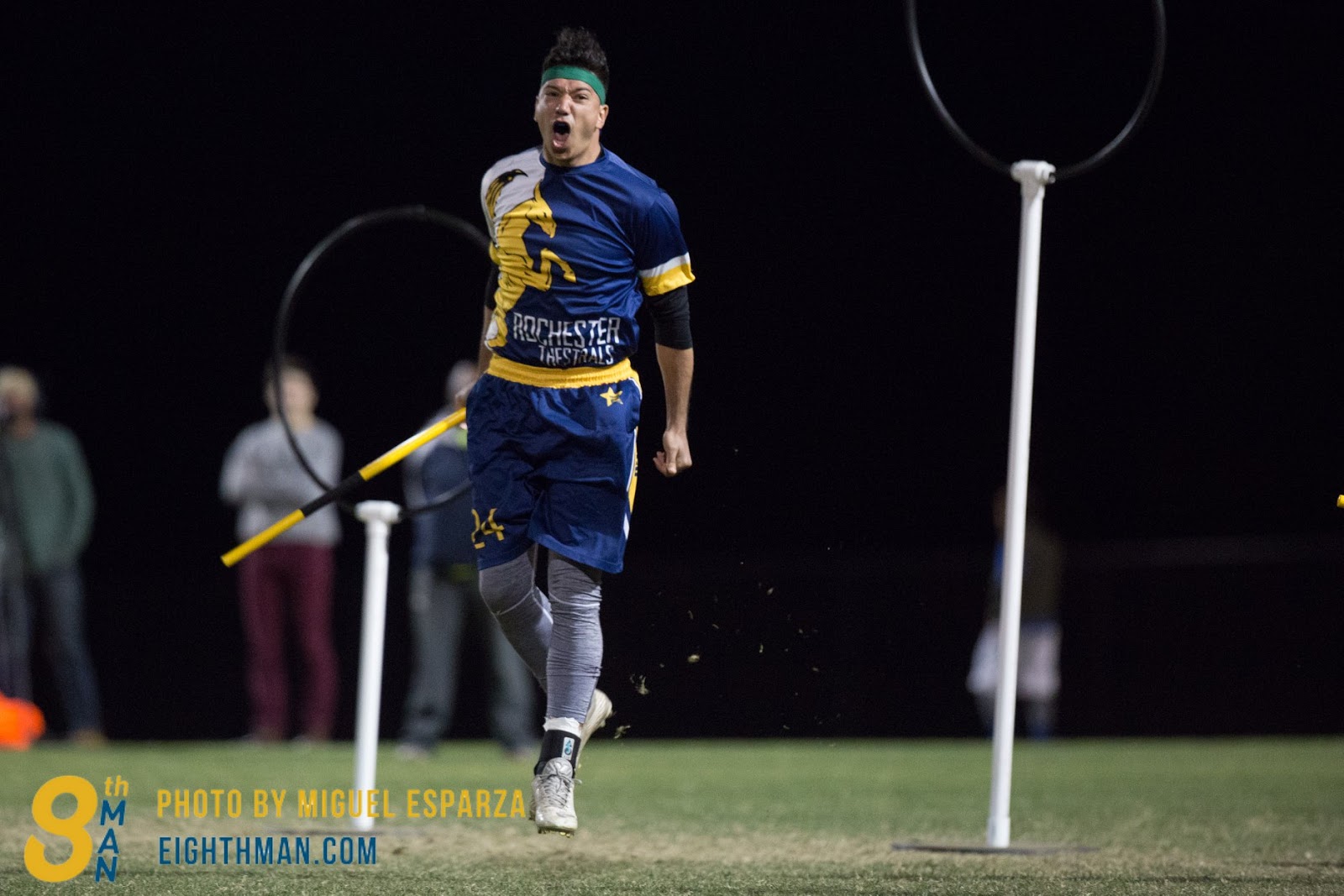
A New Champion: Thestrals from University of Rochester Defeat Longhorns

At the very beginning of the 2016-17 season, I messaged Mike Pascutoi.

Jack: "What can you tell me about URochester and RIT for this upcoming season?"

Mike: "From a completely unbiased perspective, UR has the higher ceiling but RIT is better now. RIT is older; their core is about to graduate. UR is a team built around a core of sophomores and a few juniors."

This was news to me. The University of Rochester had failed to qualify for US Quidditch Cup 9 in 2016, losing to Emerson College at the 2015 Northeast Regional Championship on their home turf. Before that, Rochester had always languished in the middle tiers of the Northeast, best known around the country for its crosstown rivalry with Rochester Institute of Technology and for an unfortunate string of losses in the first round of bracket play at Nationals (Ives Pond. Michigan State. UCLA. Blue Mountain. Florida's Finest). After missing Nationals altogether, I had counted them out and left them for dead. I certainly did not think of them as a team with a high ceiling. The prospects for any rebuilding college team looked incredibly bleak at the time.

Two years later, thanks in large part to the landmark decision by US Quidditch to divide college and community teams into separate tournaments at Nationals, Rochester is a national champion. The core of now juniors and a few seniors, supported by a fast-learning class of freshmen and vaulted over the finish line by three snitch catches from Pascutoi, defeated the three-time national champion University of Texas on Sunday. 
Photo by Miguel Esparza. Courtesy of the Eighth Man.
Heading into the finals as heavy underdogs, Rochester exploded out of the gates, scoring three consecutive goals to take a commanding 30-0 lead. Texas fought back but Rochester weathered the storm and stayed within snitch range. While anybody with memories of the Texas three-peat probably expected the Longhorns to pull first, Rochester flipped the script, prompting players from across the country to rush onto the field and mob the players. 

As the new and worthy champion, Rochester now carries the flag for the college division of the sport. Rochester becomes only the third college team to claim the US Quidditch national championship after Middlebury College and the University of Texas. The eventual champions suffered a Saturday loss to Arizona State, but finished with an impressive 9-1 record at the tournament. On the road to the championship game, Rochester defeated a long list of teams from four regions: Oklahoma State, RPI, Texas Tech, Lock Haven, Penn State, UTSA and Kansas.

Rochester's championship is even more remarkable because the team has played only two official games this spring. Over 100 inches of snow rained down on the city of Rochester this winter, making practices almost impossible. Yet, after capturing the 2017 Northeast Regional Championship with a dominant 6-0 record in November, Rochester showed few signs of rust.

Rochester is nicknamed the Thestrals, the skeletal horses from the Harry Potter series visible only to those who have witnessed death. The nickname is eerily fitting for a team that survived the crushing failure to qualify for Nationals only two years ago. A team that survived many graduations and rebuilt from the bottom up. A team that always faces one of the longest and coldest winters in the United States. A team that stumbled on Saturday, but eventually found its groove.
Photo by Miguel Esparza. Courtesy of the Eighth Man.
While quidditch should definitely celebrate its many thestrals, Rochester was not the only success story of the weekend in Round Rock. Texas and Texas State proved once again the gold standard of college quidditch programs. Without a doubt, both teams played some of the best all-around quidditch of the tournament. Several players from both teams made strong cases for Team USA this summer. While I have no idea about graduating classes, Texas and Texas State seem well-positioned for the short-term and long-term future. I was also thrilled to see UCLA, Kansas and Cal with new names and faces back in the later rounds of bracket play after an extended absence. 

But beyond wins and losses at the highest level of the sport, I think and I hope that US Quidditch Cup 11 marked a new beginning for quidditch. The large crowds and jubilant scenes under the lights harkened back to World Cup V at Icahn Stadium in New York City. The long and well-deserved tunnels, snaking across the fields, showed a healthy and supportive community. 

Over the summer, following the long-awaited announcement of a college community split, I wrote an article for this blog but never published it. I quickly forgot about it until I logged in to The QuidKid tonight. I just posted the piece, which is not exactly my best work but nicely captures the feeling at the time. Here is an excerpt from that article.

All of the sudden, the 2017-18 season is very interesting again and most of that intrigue comes from the brand new college division. Although Texas State is perhaps the early favorite, there is that exhilarating feeling that the national championship in the college division is up for grabs. It is the same feeling that made the 2012-13 season and World Cup VI so special. Back then, teams like Texas, UCLA, Baylor, Bowling Green and Emerson dared to dream because anything was possible in the absence of Middlebury. The team with much more experience and all the advantages was gone. Now that the best all-star community teams are also out of the picture, college teams can once again think big and shoot for the moon. And maybe that's what convinces an athletic recruit to stick around for another tournament or an average backup to spend extra hours in the gym.

Think about it. In less than 10 months, 21 new individuals somewhere out there right now will get to call themselves national champions. There will be school newspaper articles, victory celebrations, congratulatory tweets, social media posts, shoutouts from famous alumni and local media features. There will be much greater name recognition for the team on campus and dozens of new faces at tryouts in the fall. On a smaller scale, similar things will happen for college teams that win regional championships or make dramatic runs to the Final Four or Elite Eight. As younger, inexperienced players get a taste of success on the national stage, up-and-coming programs gain momentum for the next season. 


So get excited! The 2017-18 season and beyond now offers incredible opportunities for college teams. With all the twists and turns, it is sure going to be fun to watch.

Photo by Miguel Esparza. Courtesy of the Eighth Man
Congratulations to Rochester and all the teams that competed under the sun this weekend. You have brought new life to American quidditch! Now, it's time to turn our attention Down Under. It's time to build the Redeem Team, knock off Australia and bring the World Cup back home.

Saturday, July 1, 2017

The Future Is Now

Perhaps todayon the eve of the 2017 European Games in Oslo, Norway, in the midst of the Major League Quidditch and Quidditch Premier League seasonsit is difficult to remember that quidditch was started by college freshmen. It is difficult to remember how college students organized and traveled across the country to the very first tournamentsIt is difficult to remember that quidditch in the United States was almost exclusively played by college students until 2013

On Thursday, June 29, US Quidditch (USQ) announced that college and community teams would compete in separate divisions at regional and national championships beginning in the 2017-18 season. It was an exciting surprise from USQ—probably the best news since Alex Benepe and Alicia Redford departed the organization in 2015. It shows that USQ is thinking about a wide range of important issues including safety, liability, fairness, morale and marketing. It indicates that USQ is not satisfied with the status quo and is willing to take a big leap of faith.

As many of my old readers and social media followers know of course, I have been one of the loudest advocates for a college community split. I personally did not think this day would come until next summer or beyond. I was somewhat disengaged, even disillusioned, and I definitely was not alone. I am relieved and excited that USQ acted now but I also know that this is going to be an extremely complicated process. This is the toughest challenge that we have faced yet and we need to get it right. With that in mind, I wanted to carefully consider what the future looks like for college teams and community teams in the United States. 

College: A New Beginning
All of the sudden, the 2017-18 season is very interesting again and most of that intrigue comes from the brand new college division. Although Texas State is perhaps the early favorite, there is that exhilarating feeling that the national championship in the college division is up for grabs. It is the same feeling that made the 2012-13 season and World Cup VI so special. Back then, teams like Texas, UCLA, Baylor, Bowling Green and Emerson dared to dream because anything was possible in the absence of Middlebury. The team with much more experience and all the advantages was gone. Now that the best all-star community teams are also out of the picture, college teams can once again think big and shoot for the moon. And maybe that's what convinces an athletic recruit to stick around for another tournament or an average backup to spend extra hours in the gym.

Think about it. In less than 10 months, 21 new individuals somewhere out there right now will get to call themselves national champions. There will be school newspaper articles, victory celebrations, congratulatory tweets, social media posts, shoutouts from famous alumni and local media features. There will be much greater name recognition for the team on campus and dozens of new faces at tryouts in the fall. On a smaller scale, similar things will happen for college teams that win regional championships or make dramatic runs to the Final Four or Elite Eight. As younger, inexperienced players get a taste of success on the national stage, up-and-coming programs gain momentum for the next season. 

So get excited! The 2017-18 season and beyond now offers incredible opportunities for college teams. I can't make any guarantees but I am definitely more likely to invest my time and energy in starting a team at Williams now. Even if I am not immediately successful, I will be closely following the drama from afar. With all the twists and turns, it is sure going to be fun to watch.

Community: Two Paths
There is much more to figure out about the future for community teams. The community division at nationals is fairly straightforward. It has kind of been done before with the Bat City Showcase and it is likely to produce many great games again. There are multiple strong title contenders from across the country. It will feel smaller and different but it will still be intense and rewarding. I think most community teams realize that. 

Community divisions at regionals on the other hand are by far the biggest question mark for the upcoming season. Most regions only have enough community teams for a small tournament. To make these regionals worthwhile for community teams, USQ's staff and gameplay volunteers need to start a dialogue now with players and coaches. USQ should propose unorthodox tournament formats, discuss shortening the community competition to one day and even allow community teams in the smallest regions to go elsewhere. For example, Great Lakes community teams should probably attend the Mid-Atlantic Regional Championship in the suburbs of Pittsburgh or the Midwest Regional Championship in Madison, Wisconsin. 

On the other side of the table, community teams have to accept that regionals are going to be very different. Instead of a large two-day event with pool play and bracket play, most community teams are probably going to play a double round-robin. It will be more like the regular season in Major League Quidditch or qualification for the FIFA World Cup in soccer. Community teams will travel long distances to play two or three matches each against their closest rivals. It is not perfect but it is not the worst thing in the world. 

So there are two paths forward for community teams. First, community teams could stay involved with USQ, buying membership, attending regionals and working out the kinks together.  Second, community teams could abandon USQ and create their own cheaper alternative tournaments. I think the first path is thankfully much more likely and while I understand some of the motivation, I think the second path would be a terrible mistake.

Community teams need USQ and USQ needs community teams. USQ gives community teams legitimacy, certainty and structure. Are the best all-star community teams really going to rely on individuals to organize a national championship year after year? That is incredibly risky. What if no one steps forward one year? 

USQ is a professional organization that is known and respected by many other sports governing bodies and city tourism boards. When USQ lists a community team on its website or invites a community team to its national championship, that means something. It carries weight and presents more opportunities for official recognition by the media, government, business and civil society. Without a doubt in my mind, community teams that stick with USQ are more likely to secure sponsorships, get field space and attract new recruits in the long run.

Of course, community teams are indispensable for USQ too. Community teams introduce new strategies, recruit new athletes, provide experienced referees, develop future stars for Team USA and mentor college teams. Throughout the 2017-18 season, community teams will still entertain thousands of spectators with evenly-matched, down-to-the-wire games. Most importantly, community teams show that quidditch is dynamic and popular even beyond college campuses. 

So don't get me wrong. I think community teams are important and I think the future is bright for community teams too. Especially as MLQ becomes more structured and more closed, USQ community teams allow any group of friends to get together and rise through the ranks to the highest levels of the sport. I expect the number of community teams to continue to increase and I hope to see crosstown rivalries and local derbies soon, as well as larger and more interesting regional championships. Finally, and this is my final wish, can we start calling them club teams now?